Why Decarbonization in Low- and Middle-Income Countries is Critical to High-Impact Climate Giving
To make your donations go further, where you give matters as much as how much.
To find the places where your donation can reduce more emissions per dollar, we use the “scale, feasibility, and funding need” framework to guide our search for giving opportunities with large emissions-reduction potential, a clear role for philanthropy, and a real need for additional funding.
In recent years, this search has consistently highlighted climate action in low- and middle-income countries (LMICs) as one of the most underfunded areas in climate philanthropy.
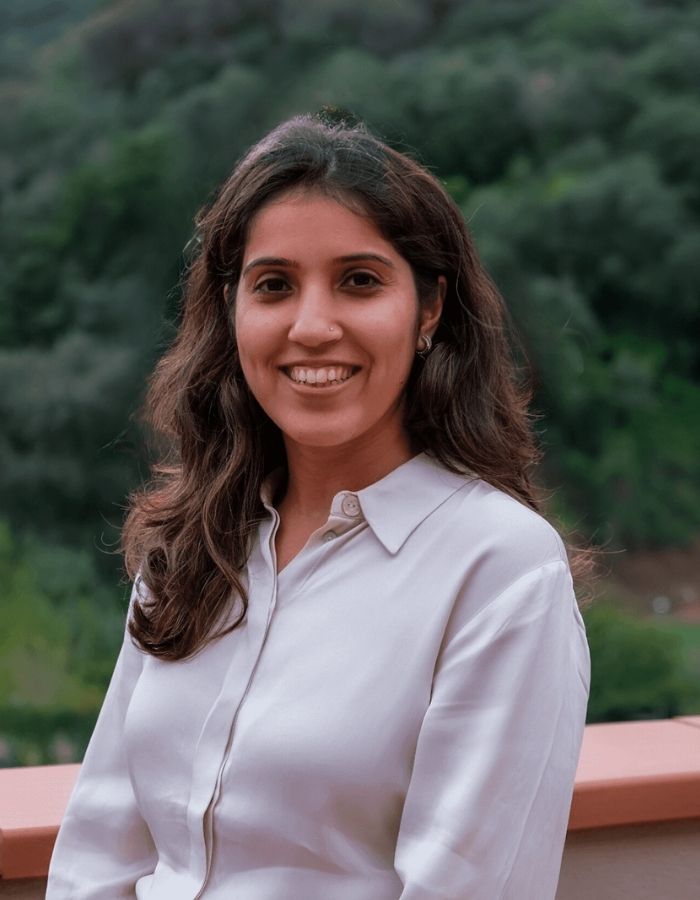
In 2026, we deepened that work by hiring an India-based senior researcher, Rama Tentu, to oversee an expanding body of research on high-impact climate giving opportunities in LMICs, alongside fellow senior researcher Diego Garrison. Rama brings essential on-the-ground insights into what’s stalling LMIC decarbonization, and where philanthropy can help. Her experience across corporate, nonprofit, and consulting sectors, including Unilever and Good Food Institute India, gives her a clear view of how systemic change happens in these economies.
"I am really excited to bring focus to India and Indonesia this year. Directing philanthropy to support climate action in these countries can not only accelerate significant emission reductions but also unlock economic growth and well-being for millions of people."
-Rama Tentu, senior researcher
As a result of this work, we directed half of the Giving Green Fund’s portfolio to support climate action in LMICs, up from 15% in 2025.
In this blog, we will walk you through our growing body of research on climate philanthropy in LMICs:
- Why Strategic Climate Donors Should Prioritize LMICs
- How We Help Donors Find High-Impact Giving Opportunities in LMICs
- LMIC Climate Solutions You Can Support Today
- Additional Resources for Impact-Minded Donors
Why Strategic Climate Donors Should Prioritize LMICs
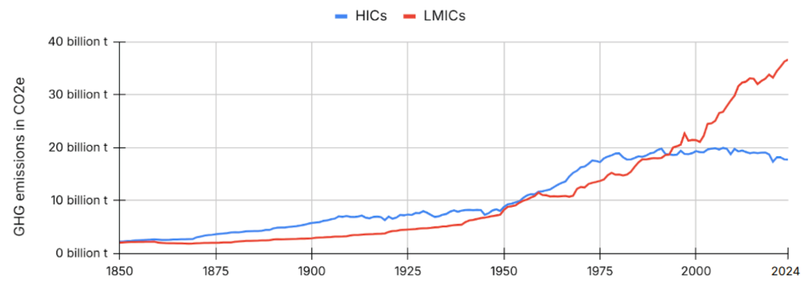
LMICs now produce about two-thirds of the world’s annual greenhouse gas emissions, and their energy demand is rising fast. Yet they receive seven to nine times less philanthropic funding per ton of emissions than their European and American counterparts, based on calculations from ClimateWorks data.
Strategic donors can help to close this gap. Specifically, three opportunities stand out:
- Economically, lower land and labor costs, plus cheap, untapped opportunities, make mitigation in LMICs especially cost-effective.
- Politically, a growing number of LMIC governments already see clean energy as serving national priorities such as energy security, economic competitiveness, and affordability.
- Timing also matters, because philanthropic support today can help these countries avoid locking in emissions-intensive infrastructure for decades.
We hold this view alongside the recognition that high-income countries (HICs) have a moral imperative to lead on decarbonization because of historical emissions. However, reductions there alone will not be enough. Even if HICs reach net zero tomorrow, nearly two-thirds of global emissions would remain.
Protecting the future means scaling up climate funding in both HICs and LMICs, and impact-focused climate donors should make LMIC giving part of a comprehensive philanthropic portfolio.
How We Help Donors Find High-Impact Giving Opportunities in LMICs
Step 1: Country Prioritization
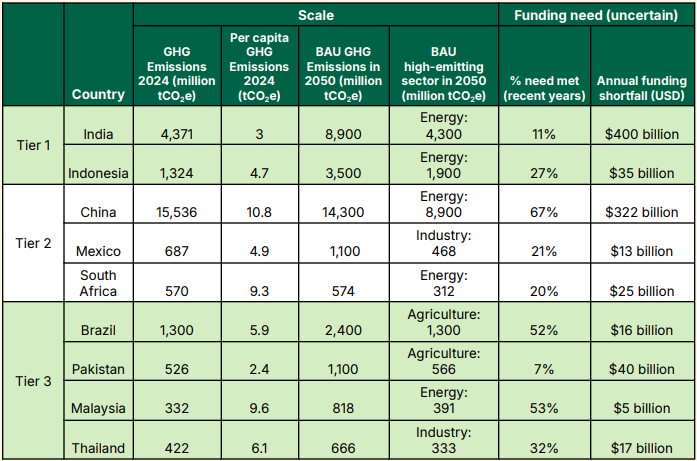
To surface concrete climate giving opportunities within LMICs, we used our “scale, feasibility, and funding need” framework to screen 131 LMICs.
India and Indonesia stood out because of their large and growing emissions, coupled with the feasibility of directing international philanthropic capital. Both are among the top 10 global emitters, and each includes sectors with projected 2050 emissions that exceed the current emissions of any other country on our shortlist except China, which we plan to explore more deeply in 2027.
Read more in our Prioritization Brief: Accelerating Climate Change Mitigation in Low- and Middle-Income Countries.
Step 2: Sector Prioritization
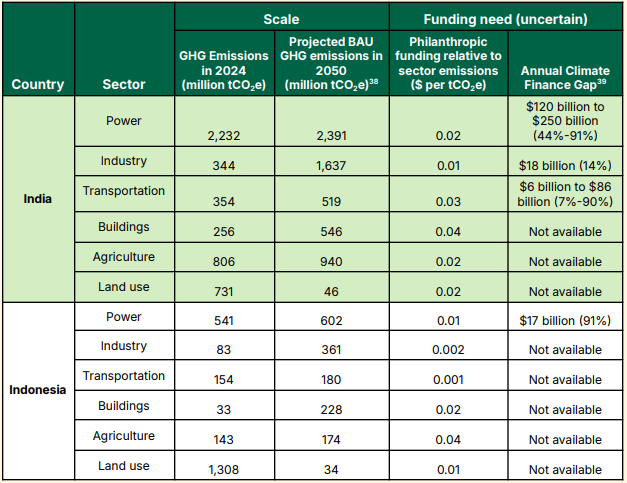
We then conducted a country-sector assessment to identify sectors in India and Indonesia where philanthropic support can be especially impactful.
The power sectors in both countries stood out for their large emissions impact and significant funding needs.
Read more in our strategy reports on Decarbonizing India's Power Sector and Decarbonizing Indonesia’s Power Sector.
Step 3: Regional and Multi-Country Strategies
Beyond our country and sector prioritizations, we examined regional and multi-country strategies that can derisk clean electricity investment across many LMICs.
Global electricity demand is rising rapidly and requires a significant increase in investment in grid and electricity generation infrastructure. LMICs, however, are experiencing a constrained flow of capital disproportionate to HICs due to challenges and roadblocks that increase the risk of investing in LMIC markets. Because many of these risks are shared, regional strategies can support progress and unlock investment at a scale that country-specific efforts alone are unlikely to reach. Your donations can play a catalytic role in lowering the barriers—financial, regulatory, and technical—that hinder investment in clean electricity in LMICs.
Read more in our Strategy Report: Derisking Clean Electricity Investments in LMICs
LMIC Climate Solutions You Can Support Today
Our research shows that, despite their growing emissions, LMICs receive a relatively small share of climate philanthropy, so your donation can go further there. We also found an abundance of concrete, evidence-based opportunities that are ready to receive funding today.
For donors ready to take action, we recommend giving to the Giving Green Fund, which supports a portfolio of research-backed climate initiatives through a single transaction and without management fees.
Below is a selection of Giving Green Fund grantees that lead high-impact climate work in LMICs. We are also supporting a number of organizations whose global work reaches LMICs. Additionally, we are funding industrial decarbonization work spearheaded by the for-profit think tank, Centre for Research and Implementation for Decarbonization (CRID). For the full list of organizations and the strategies being supported, visit the Giving Green Fund page on our website.
- Alliance for Just Deliberation on Solar Geoengineering (DSG)
- Center for Study of Science, Technology and Policy (CSTEP)
- Council on Energy, Environment and Water (CEEW)
- Dao Foods
- Degrees Initiative
- Duke University’s Nicholas Institute
- Global Power System Transformation Consortium(G-PST)
- Institute for Development of Economics and Finance (INDEF)
- Institute for Energy Economics and Financial Analysis (IEEFA)
- Institute for Essential Services Reform (IESR)
- International Centre for Diarrhoeal Disease Research, Bangladesh (icddr,b)
- International Forum for Environment, Sustainability & Technology (iFOREST)
- Mission Possible Partnership, Industrial Transformation Accelerator India
- Open Energy Transition (OET)
- ProVeg International
- Regulatory Assistance Project (RAP)
- RMI (Global)
- RMI China
- RMI India
- Vasudha Foundation
- World Resources Institute(WRI) Indonesia
Additional Resources for Impact-Minded Donors
1. Learn more at our Giving Tuesday webinar

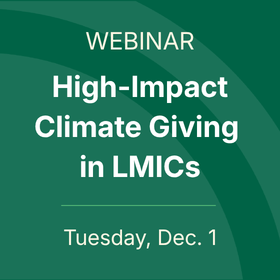
Take a deep dive into high-impact giving opportunities in LMICs at our Giving Tuesday webinar with our founder and executive director, Dan Stein, and our lead LMIC researcher, Rama Tentu. You’ll also hear directly from leaders of climate organizations working in India, Indonesia, and other LMICs on how change happens on the ground.
2. Reach out for 1:1 advisory
We understand that donors come with unique motivations and constraints. Contact us via our website for more personalized giving guidance.
Related News






























































Support Our Work
Giving Green Fund
One fund. Global impact. One hundred percent of your gift supports a portfolio of high-impact climate organizations, vetted by our research.
Best for:
Donors who want the simplest way to impact multiple climate solutions.
Top Climate Nonprofits
Meet the organizations on Giving Green’s list of high-impact nonprofits working to decarbonize our future, identified through our rigorous research.
Best for:
Donors who want to give directly and independently.
Support Our Work
We thoroughly research climate initiatives so you can give with confidence. For every $1 we receive, our work unlocks another $25.90 for effective climate solutions.
Best for:
Donors who want to amplify their impact through research.