Voices of Impact: Ann Garth on Why Superhot Rock Geothermal Is Ready to Scale
CATF’s modeling estimates that just 1% of the world’s superhot rock geothermal heat could produce 63 terawatts of power—about eight times more than all the electricity the world uses right now.
Clean Air Task Force (CATF) has been a long-standing Top Climate Nonprofit at Giving Green. The global organization focuses on clean technologies that are either nascent or lack broad support from civil society, and it has a history of successfully advocating for a wide array of climate provisions.
We are particularly impressed that CATF has built momentum for areas of innovation that need more funding support, such as superhot rock geothermal energy, zero-carbon fuels, and the decarbonization of aviation and maritime shipping.
As part of our new Voices of Impact series spotlighting Giving Green’s Top Climate Nonprofits and Giving Green Fund grantees, we connected with Ann Garth, Policy Manager for the Superhot Rock Geothermal program at CATF, who took us on a deep dive into next-generation geothermal energy. She laid out CATF’s vision for superhot rock geothermal to produce enormous amounts of clean, affordable energy.
The Q&A has been edited for brevity and clarity. The views and experiences shared in this conversation are those of the authors and reflect their unique perspective. We are grateful to them for sharing their story with us.

Q: Could you briefly introduce yourself, share your career path, and explain what led you to your role as Policy Manager at Clean Air Task Force (CATF)? For readers who may be unfamiliar, please briefly describe what CATF is and what it does.
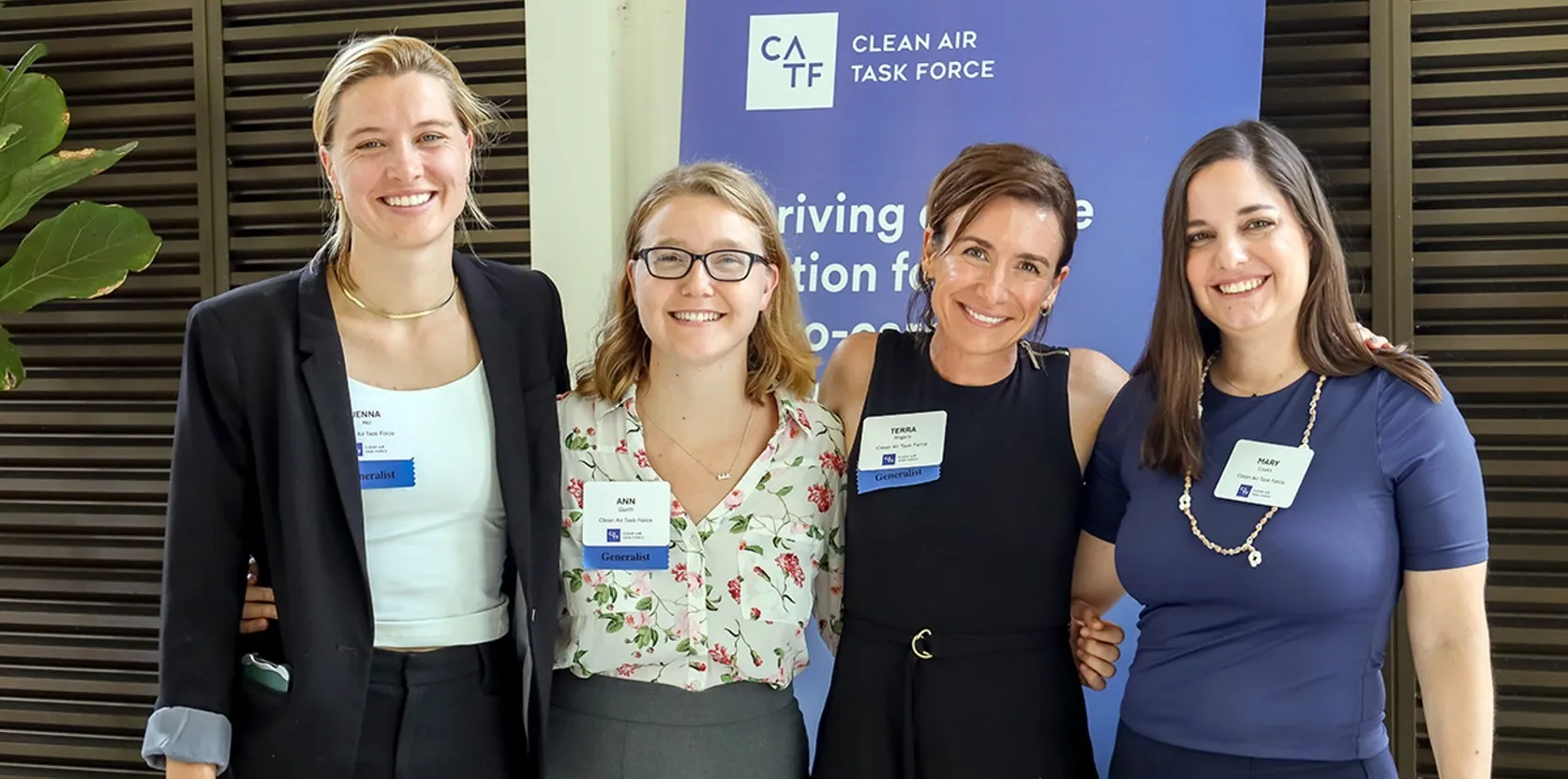
My name is Ann Garth and I'm a Policy Manager on the Superhot Rock Geothermal team at Clean Air Task Force (CATF). CATF is a global nonprofit that pushes the technology and policy changes needed to achieve a zero-emissions, high-energy planet at an affordable cost. We have teams active in many different areas, from transmission infrastructure to methane leaks to nuclear fusion and beyond. Mitigating climate change has been one of my life’s goals for as long as I can remember, so when I was ready to get a job working on climate change, I looked for nonprofits that were having a high impact and “punching above their weight”. I focused on organizations that had been rated highly by nonprofit evaluators I trusted, like Giving Green, and was lucky to end up on the Superhot Rock Geothermal team at CATF.
Q: Could you explain what geothermal energy and superhot rock energy are, and why superhot rock energy is important for the future of clean energy?
Geothermal energy is a source of renewable energy that uses the Earth’s heat. For a long time, geothermal energy for power generation was limited to only places with preexisting pockets of hot water. There aren’t many places like that, so geothermal was a small player in the energy transition. Next-generation geothermal changed the game—instead of looking for pockets of hot water, developers bring their own water, which makes it possible to produce geothermal energy anywhere the rock is hot. This change dramatically widens the potential for geothermal energy around the world.
Superhot rock geothermal (SHR) is the hottest form of geothermal, generally at temperatures of around 375°C or above. It has much more energy than lower-temperature forms of geothermal, which makes it especially high in potential. CATF’s modeling estimates that just 1% of the world’s superhot rock geothermal heat could produce 63 terawatts of power—about eight times more than all the electricity the world uses right now.
Geothermal energy also has a small land footprint, which can help minimize land-use conflicts associated with electricity generation. And the geothermal energy workforce is almost identical to the oil and gas workforce, which means that there is an opportunity to transition the oil and gas workforce toward renewable energy. Those benefits together create a very exciting value proposition.
Q: What are CATF’s main goals for superhot rock geothermal today, and what are the biggest technical or market barriers you are working to overcome?
CATF’s long-term goal is for superhot rock geothermal to produce enormous amounts of renewable energy at an affordable cost. Reaching that goal will require technical innovations, better models for financing and market support, and action from policymakers.
In terms of technical innovations, there are technical gaps that need to be overcome to help superhot rock geothermal deploy. One of the biggest overarching findings from CATF’s research is the need for testing spaces (in labs and in the field).
On the market and financing side, we focus on educating and connecting venture capital and potential investors. Private capital is beginning to recognize the enormous potential of next-generation geothermal, but there is still work to do to accelerate projects and deal flow, as we found at an event we recently co-hosted with MIT.
When it comes to policy, there is a lot that governments at all levels—state, federal, and multinational—can do to help geothermal deploy safely and at scale. Right now, I’m finalizing a series of reports that lay out the highest-impact policy actions to help understand the subsurface, clarify and streamline regulatory processes, finance early projects in new regions, help geothermal connect to the larger energy system, and support innovation.
Q: Stakeholder engagement plays a major role in CATF’s strategy. Which stakeholder group has been the most challenging to engage, and how does your approach differ when working in the United States compared to other regions?
We work with a wide range of stakeholders: the geothermal industry, governments, academics, other environmental nonprofits, oil and gas companies, investors, the media, and even the general public.
Geographically, CATF is currently active on geothermal energy in the U.S. and Europe, although we’re eager to expand further, resources permitting. Our biggest challenge with stakeholder engagement in both the U.S. and Europe isn’t with a specific group but more of a trend across all groups: lack of knowledge. Though geothermal is getting more media coverage these days, many people are still unfamiliar with it. They may confuse geothermal power plants with hot springs, geothermal heat pumps (which provide heating and cooling for individual homes), or district heating systems which heat small groups of buildings. The concepts of next-generation and superhot rock geothermal are even less familiar.
Q: Giving Green has recognized CATF’s work as a top climate mitigation strategy. How has this recognition supported your efforts on superhot rock geothermal, and how can new supporters have the greatest impact in advancing this technology?
We are honored to be recognized by Giving Green for our superhot rock geothermal work. CATF was the first NGO in the world to focus specifically on superhot rock geothermal, and we’re still one of the only organizations that work in this space. We were willing to go it alone on superhot rock geothermal because we genuinely believe in its potential for impact, and we are thrilled that Giving Green’s research backed this up as well. The support of Giving Green’s donors has been crucial to scaling and expanding our impact over the past four years.
Giving Green’s recognition is also a crucial way for CATF to signal to other potential funders and donors that geothermal is an important energy source and that CATF does good work on this topic. Geothermal is new to most people, including many philanthropists and donors. Giving Green is playing an important role in the geothermal funding ecosystem by indicating which organizations should be considered high-impact in this space.
New supporters of our work can help advance superhot rock geothermal by raising awareness that it exists, encouraging folks they know to learn more about geothermal, and donating to CATF.
Q: What is one major accomplishment that best illustrates how donations or support translated into real-world impact?
One of my team’s biggest priorities has been identifying and overcoming technical gaps. In 2024 we worked with leading experts from around the world to write a series of reports which provide the first-ever comprehensive landscape of the gaps to commercializing superhot rock geothermal and how those gaps could be overcome. We also hosted an event called the Superhot Rock Summit, which brought together leading geothermal stakeholders—industry, academics, and government researchers—to discuss the report findings. Last year, we published a roadmap report that clearly laid out the next steps for overcoming superhot rock geothermal technical gaps based on the conversations at the Summit.
This work helped inspire a program from Advanced Research Projects Agency-Energy (ARPA-E), a U.S. government group that funds energy innovation. The ARPA-E program will spend $30 million USD to help close the most important technical gaps that our research identified. We can trace a clear line of impact from the donations, which allowed us to write the reports and host the Summit, to the learnings and information-sharing we did as part of that process, to the $30 million of government funding we inspired.
Our research has also translated into legislative wins. Starting in 2022, CATF conducted a years-long listening tour with industry to identify the most critical research and development (R&D) gaps standing in the way of superhot rock scaling. We then developed tailored R&D concepts and worked with lawmakers on both sides of the aisle to design legislation addressing those challenges. That work recently paid off—in 2026, CATF's efforts directly led to the introduction of the bipartisan Next-Generation Geothermal Research and Development Act in both chambers. The Senate bill—led by Senators Cortez-Masto (D-NV) and Murkowski (R-AK)—marks the first time superhot rock legislation has been successfully introduced in the Senate. The companion House bill, introduced by Reps. Salinas (D-OR) and Harrigan (R-NC), was quickly passed out of committee. This legislation would bolster federal funding for next-generation geothermal research, development, and commercialization.
The work isn’t over—we hosted a second Summit in June 2026. We want this to be an ongoing process of overcoming technical gaps, figuring out what gaps remain and which are most important, overcoming those gaps, and repeating.
Q: If CATF were to receive a significant increase in funding from Giving Green-aligned donors over the next year, what specific elements of your superhot rock geothermal program would you expand or accelerate?
There is so much more that we could do with increased funding. Additional resources would allow CATF to expand its work in Europe and at the state-level in the U.S., as well as expand our international collaboration efforts and our technical research. This would mean things like shaping policy in more places, supporting data-sharing among different superhot rock projects, pushing for testbeds and funding to advance superhot rock geothermal R&D, improving industry and governmental collaborations, doing more research on the technical aspects of superhot rock geothermal and how it overlaps with the energy system, and more.
Q: If you could correct one major myth about geothermal energy, what would it be, and what advice would you give readers passionate about climate action but new to geothermal solutions?
One major myth about next-generation geothermal energy is that it’s entirely new. Next-generation geothermal in the U.S. has only recently become affordable enough to scale broadly, but many of the underlying technologies and approaches have been used for decades in test and pilot projects around the world.
Because most people haven’t heard about geothermal until recently, and because technological innovations are being announced all the time, it might feel like this is a new space where everything is still up in the air. But the truth is that geothermal, even next-generation geothermal, is a tested and effective energy source. The industry is continuing to advance technology and approaches, but they’re building off a strong preexisting base of knowledge.
For readers who are passionate about climate action but new to geothermal, my suggestion is to stay informed and keep an eye out for opportunities to get more involved. CATF regularly posts blogs, reports, and other information about superhot rock geothermal.
Q: Has the current U.S. political environment affected CATF’s geothermal work, and what major risks or opportunities do you see for superhot rock development under today’s political landscape?
One of the things I love the most about working on geothermal energy is that it’s a bipartisan energy source with strong support from across the political spectrum. Regardless of which party is in charge, we can make progress on geothermal policy. There are opportunities for superhot rock development through a whole range of policies—including R&D funding, support for demonstration projects, gathering and sharing subsurface data, setting up testbeds, better coordination on permitting and environmental reviews, and so much more.
Related News

.webp)
.webp)

.webp)

.webp)

.webp)

.webp)

.webp)






.webp)
.webp)




.webp)

.webp)
.webp)

.webp)





.webp)

.webp)
.webp)




.webp)


.webp)



.webp)
.webp)




.webp)

.webp)
.webp)
Support Our Work
Giving Green Fund
One fund. Global impact. One hundred percent of your gift supports a portfolio of high-impact climate organizations, vetted by our research.
Best for:
Donors who want the simplest way to impact multiple climate solutions.
Top Climate Nonprofits
Meet the organizations on Giving Green’s list of high-impact nonprofits working to decarbonize our future, identified through our rigorous research.
Best for:
Donors who want to give directly and independently.
Support Our Work
We thoroughly research climate initiatives so you can give with confidence. For every $1 we receive, our work unlocks another $25.90 for effective climate solutions.
Best for:
Donors who want to amplify their impact through research.