Giving Green Launches New Biodiversity Research and Top Biodiversity Nonprofits
At Giving Green, we focus on directing funding toward highly effective climate mitigation strategies. Recently, however, an anonymous donor approached us with an opportunity to use our research methods to identify where limited philanthropic dollars could have an outsized impact on declining biodiversity.
We’re thrilled to finally share our learnings from this consulting project in our new strategy report on Reducing Biodiversity Loss. As a result of our research, the donor who backed this project donated a total of $1,830,000 to the high-impact biodiversity nonprofits we identified.
We are grateful that the donor agreed to make this research public in the hopes that the findings could guide others who share a passion for biodiversity and want to make their donations count—whether they have $1 or $1 million to give.
Before we go further, we want to make it clear that addressing climate change remains at the heart and soul of Giving Green’s mission. Rest assured that our research into high-impact climate giving strategies and Top Climate Nonprofits remains our priority, and 100% of donations to the Giving Green Fund will continue to fund climate solutions.
For now, this biodiversity research is purely educational and advisory in nature. One day, if we receive enough interest and demand, we may consider starting a separate biodiversity fund informed by this workstream.
The Biodiversity Funding Gap
Before we share our findings, let’s review the state of declining biodiversity:
- Natural ecosystems have declined by 47% from their earliest estimates.
- Ecosystems are critical for human flourishing, and 23 out of the 27 studied essential services they provide are trending downward.
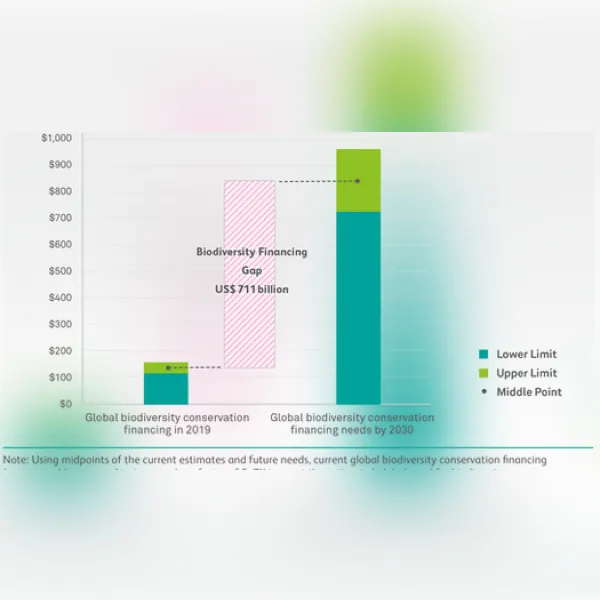
- To meet global biodiversity goals, including the protection 30% of land and sea by 2030, the biodiversity financing gap requires an estimated $700 billion per year.
Currently, philanthropy represents just 2% of total biodiversity funding—about $3 billion annually, compared to roughly $77 billion in government funding and $27 billion in private investment such as green bonds.
Given philanthropy’s small share, simply calling for more money is not enough.
Instead, we need to shift focus to the quality of philanthropic donations. That means smarter, more strategic grantmaking that optimizes for impact and reimagines the systems responsible for habitat loss.
Given philanthropy’s dwarfed share of biodiversity funding, the sector’s best chance to catalyze impact is to fill gaps left by public and private capital.
High-Impact Strategies for Land and Freshwater Biodiversity
.webp)
On land, the leading driver of biodiversity loss is land use change—converting nature into farmland—and the resulting habitat loss.
Our research suggests that by targeting this issue, philanthropists could reduce extinction risks by up to 85%.
While land use change gets plenty of attention in biodiversity circles, philanthropic funding tends to be focused on location-specific projects or forest conservation, neither of which has the global or regional impact potential to advance long-term, systemic change.
As a result of our research, we recommend focusing on two high-leverage strategies.
1. Advocating for Alternative Protein Policy and Research
Livestock production drives cropland expansion.
Our findings indicate that supporting the innovation and adoption of alternative proteins that are as tasty and affordable as traditional meat could reduce the expansion of croplands by up to 82% by 2050.
2. Wetlands Protection
Wetlands make up just 10% of global land area, yet support up to 40% of the world’s species. These habitats also provide the highest value of ecosystem services per hectare per year out of all major natural biomes.
Together, these strategies balance long-term systems change (alternative proteins) with near-term habitat conservation (wetlands).
High-Impact Strategies for Marine Biodiversity
.webp)
Marine biodiversity is often overlooked, receiving only about one-tenth of environmental grantmaking in the U.S. In the U.K., coastal and marine ecosystem protection receives nearly five times less funding than terrestrial ecosystem protection, according to analysis by the Environmental Funders Network.
Yet oceans provide critical services such as food, carbon storage, and coastal protection.
The greatest risk to marine life is fishing, which threatens 72% of vulnerable or endangered marine species.
Based on our research, two strategies targeting fishing stood out.
1. Reducing Bycatch
Bycatch is the unintended capture of non-target species in fishing practices. It can be reduced through the development and implementation of improved fishing gear.
Philanthropy has an opportunity to play an important role in piloting, implementing, and regulating improved fishing gear, such as anti-bycatch devices. These solutions all have the opportunity to be scaled up regionally and globally.
2. Fish Meal & Fish Oil (FMFO) Alternatives
About 13% of wild fish catch by weight is used for producing FMFO.
To decrease the global demand for wild-caught fish, donors should consider funding the innovation and adoption of alternatives.
Top Biodiversity Nonprofits
Our research uncovered two Top Biodiversity Nonprofits that we’re really excited about. Both work on lowering biodiversity loss in land and in freshwater habitats.

The Good Food Institute (GFI) is a global nonprofit that seeks to make alternative proteins competitive with conventional proteins in terms of price and taste via science, policy, and industry workstreams. By lowering livestock production and the land it requires, GFI’s work to advance alternative proteins can help reduce future habitat loss.

Wetlands International is a global nonprofit organization working to safeguard and restore wetlands for their environmental value and ecosystem services. Wetlands International’s work to conserve and restore wetlands at scale is important for protecting the ecosystem services they provide and the species that depend on them.
What About Climate Mitigation for Biodiversity?
Climate change is the fourth leading driver of biodiversity loss on land and the second largest in oceans. As warming continues, biodiversity risks will intensify.
For donors whose top priority is addressing biodiversity loss, we recommend following our recommendation to focus on solutions to land use change and fishing.
However, those who care about both climate change and biodiversity could consider donating to the Giving Green Fund or directly supporting our Top Climate Nonprofits.
We’d especially encourage anyone who cares about both of these causes to donate to organizations dedicated to addressing the role of agriculture in food systems emissions and habitat loss, such as The Good Food Institute—a Top Climate Nonprofit and Top Biodiversity Nonprofit.
How You Can Give to Effective Biodiversity Solutions
The best way to put our research and recommendations into practice is by donating directly to our Top Biodiversity Nonprofits, The Good Food Institute and Wetlands International.
If you’re passionate about lowering biodiversity loss in oceans, we encourage you to reach out for more nuanced guidance and recommendations.
While we found promising opportunities worthy of restricted funding, this research did not result in any Top Biodiversity Nonprofits addressing marine habitat loss. However, we did work with the anonymous donor to recommend specific restricted grants to the Sustainable Fisheries Partnership and the Centre for Feed Innovation.
We believe there is an opportunity for greater innovation and ecosystem building, and we will continue looking for promising and strategic opportunities for unrestricted funding.
Want to Learn More?
Join us on March 17 for a webinar breaking down all of our biodiversity research and recommendations!
You’ll hear from our lead researcher on this project, our two Top Biodiversity Nonprofits, and other industry experts.
Register for the webinar here.
As always, we welcome you to reach out with questions, feedback, requests for personalized climate giving support, collaboration inquiries, etc. Whatever it may be and wherever you are in your climate journey, we want to hear from you! Contact us here.
Related News


.webp)

.webp)

.webp)

.webp)





.webp)


.webp)
.webp)
.webp)




.webp)
.webp)




.webp)




.webp)
.webp)


.webp)


.webp)
.webp)

.webp)
.webp)

.webp)



.webp)

.webp)

.webp)


Support Our Work
Giving Green Fund
One fund. Global impact. One hundred percent of your gift supports a portfolio of high-impact climate organizations, vetted by our research.
Best for:
Donors who want the simplest way to impact multiple climate solutions.
Top Climate Nonprofits
Meet the organizations on Giving Green’s list of high-impact nonprofits working to decarbonize our future, identified through our rigorous research.
Best for:
Donors who want to give directly and independently.
Support Our Work
We thoroughly research climate initiatives so you can give with confidence. For every $1 we receive, our work unlocks another $25.90 for effective climate solutions.
Best for:
Donors who want to amplify their impact through research.