Casa Pueblo: Nonprofit Evaluation
Summary
- What is Casa Pueblo?
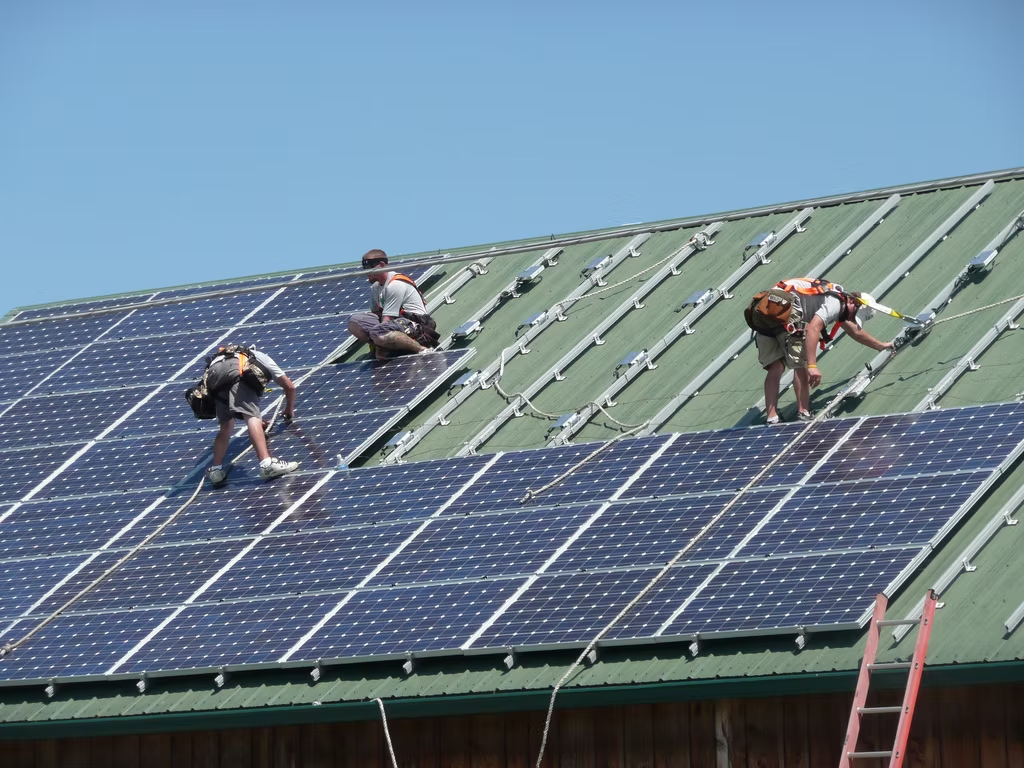
Casa Pueblo is a long-standing, community-based environmental organization headquartered in Adjuntas, Puerto Rico. Founded in 1980, it works at the intersection of environmental protection, community self-determination, and sustainable development. Over the past two decades, Casa Pueblo has become a leading practitioner of community-owned renewable energy in Puerto Rico. It deploys solar energy systems, microgrids, and resilience hubs to support households, small businesses, and critical community infrastructure, while embedding this work in education, culture, and local governance.
- How could Casa Pueblo support climate objectives in Puerto Rico?
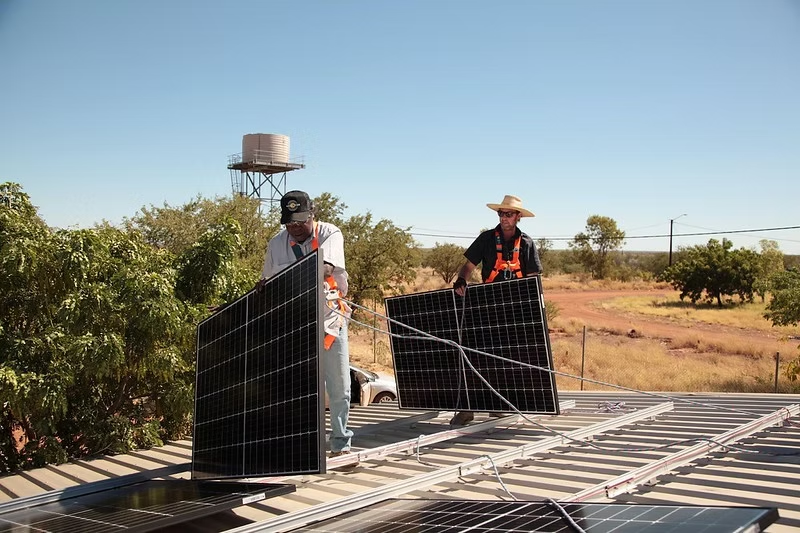
Casa Pueblo improves energy resilience by deploying community-owned solar and battery microgrids that operate during outages and by strengthening local technical capacity through applied research and hands-on training to support broader replication.
- What is Casa Pueblo’s theory of change?
Casa Pueblo’s theory of change is grounded in the belief that Puerto Rico’s capacity for climate adaptation and the challenge of its colonial dependency must be addressed from the ground up through processes of community-led decolonization within our political reality. This pathway centers on the defense of our territories and natural resources, cultural resistance, and the collective development of community-owned distributed solar systems and networked microgrids supported by local technical capacity, enabling communities to build energy independence from the ground up while strengthening resilience, reclaiming democratic control over essential infrastructure, and advancing a just ecosocial transition.
- Is there room for more funding?
Casa Pueblo has meaningful room for additional funding, particularly to advance innovation and development while expanding solar microgrids across the urban area of Adjuntas as a replicable model for other municipalities. The long-term aspiration is Adjuntas Pueblo Solar—a town-scale ecosystem of interconnected community microgrids that demonstrates how local energy independence can be built from the ground up. While core operations are sustained through earned revenue and general donations, energy initiatives often rely on one-off, project-specific grants. Additional funding would allow Casa Pueblo to accelerate the deployment of community solar microgrids, strengthen applied research and workforce training through the Living Energy Innovation Laboratory, and amplify a model of energy resilience rooted in community ownership and local technical capacity.
- Are there major co-benefits or potential risks?
The long-term scalability of networked microgrids may be limited by regulatory or utility-level constraints related to interconnection rules or the implementation of research-based innovations. However, Casa Pueblo approaches these challenges through a form of community-based advocacy grounded in action—demonstrating viable solutions in practice in order to help reshape regulatory frameworks and institutional structures. By building and operating working models of distributed solar and community microgrids, the organization seeks not only to improve local resilience but also to catalyze policy evolution that enables broader adoption of decentralized, community-driven energy systems.
- What are the key uncertainties and open questions?
The key uncertainty is less about whether interconnected community microgrids will emerge beyond Adjuntas, and more about when the current lag phase between innovation and broader adoption will begin to close. The expansion of networked microgrids will depend in part on regulatory frameworks, utility cooperation, and institutional willingness to adapt to decentralized energy systems. Through community-led implementation and advocacy grounded in action, Casa Pueblo seeks to reduce this lag phase—demonstrating viable alternatives in practice and helping accelerate the transition toward a decentralized energy system rooted in community ownership, resilience, and local capacity.
- What is the bottom line and what are the next steps?
This research was conducted as part of a consulting project to help a client find the most impactful climate nonprofits in Puerto Rico. As explained in our strategy report produced as part of this engagement, we recommended that the client focus on energy resilience and reliability. As part of this strategy, we recommended that our client make a grant to Casa Pueblo based on its strong track record of deploying resilient community-owned energy systems and its strategic focus on coupling infrastructure with applied research and workforce training to support scalable, decentralized resilience.
Donors interested in supporting its work can make a direct donation to Casa Pueblo.
This is a non-partisan analysis (study or research) and is provided for educational purposes. Unless otherwise cited, information in this nonprofit evaluation comes from direct correspondence with Casa Pueblo.
Casa Pueblo is a community-based organization that is fiscally sponsored by Haser Cambio, a 501(c)(3) tax-exempt organization in the United States.
Questions and comments are welcome at hello@givinggreen.earth.
What Is Casa Pueblo?
How Could Casa Pueblo Address Energy Resilience and Reliability in Puerto Rico?
What is Casa Pueblo’s Theory of Change?
Is There Room for More Funding?
Are There Major Co-Benefits or Potential Risks?
Key Uncertainties and Open Questions
Bottom Line and Next Steps
Explore More Climate Giving Research






.webp)


.webp)
.webp)

.webp)

.webp)

.webp)
.webp)
.webp)
%20(1).webp)
.webp)
.webp)
.webp)
.webp)
.webp)
.webp)
%20(1).webp)












.webp)

.webp)

.webp)

.webp)

.webp)
.webp)
.webp)
.webp)

.webp)

.webp)
.webp)



.webp)
.webp)

.webp)


.webp)

.webp)
.webp)

.webp)
.webp)
.webp)
.webp)
.webp)


Support Our Work
Giving Green Fund
One fund. Global impact. One hundred percent of your gift supports a portfolio of high-impact climate organizations, vetted by our research.
Best for:
Donors who want the simplest way to impact multiple climate solutions.
Top Climate Nonprofits
Meet the organizations on Giving Green’s list of high-impact nonprofits working to decarbonize our future, identified through our rigorous research.
Best for:
Donors who want to give directly and independently.
Support Our Work
We thoroughly research climate initiatives so you can give with confidence. For every $1 we receive, our work unlocks another $25.90 for effective climate solutions.
Best for:
Donors who want to amplify their impact through research.