What is carbon dioxide removal, and why is it important?
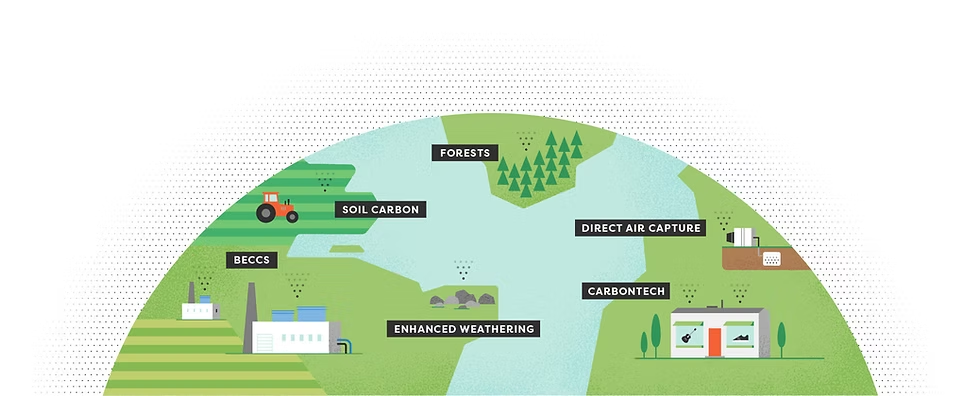
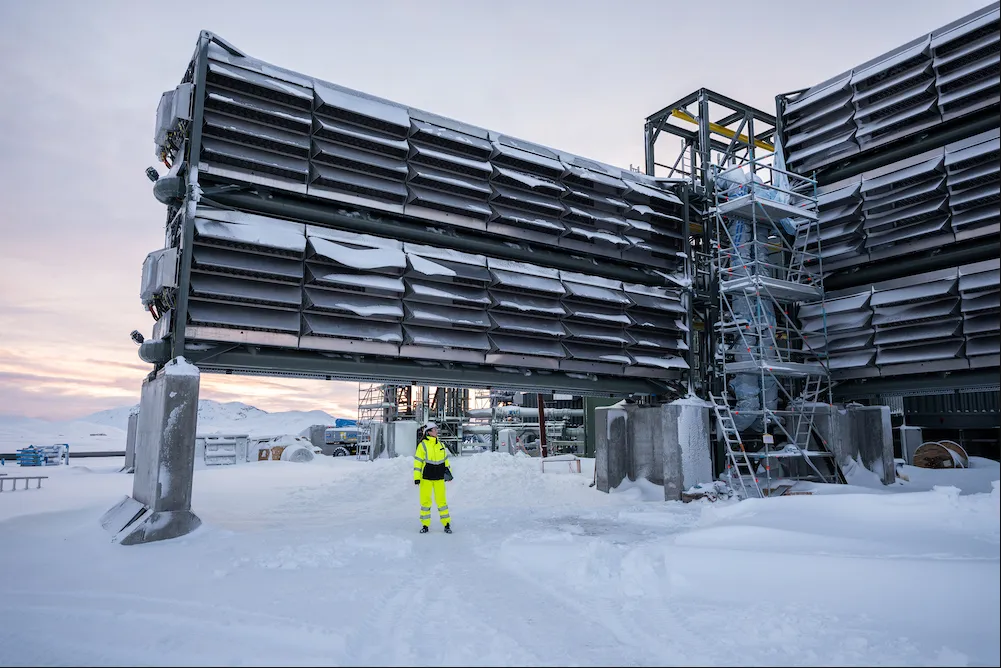
Carbon dioxide removal (CDR) methods remove CO2 from the atmosphere and durably store the carbon in other carbon pools, such as the ocean, soils, or underground reservoirs. Conventional methods, such as afforestation, are already deployed at scale. Novel methods, such as direct air carbon capture and storage (DACCS), bioenergy with carbon capture and storage (BECCS), and enhanced rock weathering (ERW), are largely undeployed.
CDR can reduce net emissions and, in the long term, undo lingering historical emissions (also known as “legacy emissions”). It can also hedge against three distinct risks:
It provides optionality if hard-to-abate sectors or countries fail to decarbonize.
It offers a way to respond to a stronger climate system reaction to emissions than typical forecasts suggest.
It might enable reversing global warming.
How much CDR is needed, and how far off track is deployment today?
Total CDR in 2025 was 2.2 billion metric tons of CO2 (tCO2), of which almost all (99.95%) came from re-/afforestation. A reanalysis of the Intergovernmental Panel on Climate Change (IPCC) scenarios suggests that 5.5-9.4 billion tons of CDR per year is required by 2050 to limit warming to 2°C (>67% probability) by 2100. Conventional methods cannot close this gap on their own because of land competition and reversal risks, so we think it is important to scale up novel CDR methods.
How could efforts to scale CDR reduce greenhouse gas concentrations?
Carbon removal is a public good, so demand for it has to be created rather than discovered. The voluntary carbon market has driven most novel CDR demand to date, but we expect it to remain fragile and limited in scale. Larger volumes are more likely to come from compliance mechanisms such as emissions trading systems and from integrating CDR into existing industrial policies in sectors such as agriculture, mining, and wastewater.
The incentive type best suited for a given CDR method depends on measurability. Credit-based systems rely on ton-for-ton claims and therefore require durable CDR methods with precise monitoring, reporting, and verification (MRV). Sectoral integration and industrial policies often do not, which makes them promising sources of demand for CDR methods where MRV costs are high.
What do our findings suggest are the most promising philanthropic sub-strategies for scaling CDR?
Based on our evaluation of scale, feasibility, and funding need, we think the most promising philanthropic sub-strategies are creating demand for CDR through compliance mechanisms and/or alternative demand mechanisms, and improving MRV and setting standards for novel CDR, especially for open-system processes. We think that demand generation, MRV, and standards are important and solvable barriers to scaling CDR. We may also support efforts to advance research, development, and demonstration (RD&D) of novel CDR, especially for methods with the potential to bring down the cost of CDR that are otherwise unlikely to receive funding.
Is there room for more funding?
We think there is substantial room for more funding to scale CDR. Our understanding from conversations with funders and experts is that funding is declining. Major donors have exited the space since 2024, and several smaller funders have retreated without a public announcement.
Most CDR funding has supported science and innovation rather than demand creation, MRV, or standards. Conventional climate funders often do not support novel CDR at all, which we attribute to risk aversion, concerns that this work could reduce or delay mitigation, and the absence of an institutional home for CDR within their portfolios.
Are there major co-benefits or potential risks?
Depending on the method and demand pathway used, CDR has co-benefits for biodiversity, economic development, and agricultural yields. At the same time, CDR can create a mitigation deterrence risk, especially if policies and sectors rely on CDR to decarbonize but removals underperform. CDR-dependent mitigation pathways are also at risk of policy reversal, unlike abatement strategies that can create technological lock-in. Large-scale deployment could also compete for land and energy, which requires strong governance.
What are the key uncertainties and open questions?
While we think CDR is an important component of climate change mitigation, we are uncertain about the feasibility of growing CDR deployment, partially due to the unknown price floor of CDR. We are also uncertain how much demand sectoral integration can generate. Untapped demand opportunities likely exist within existing industries, though their aggregate scale is uncertain. We think this uncertainty can be resolved through philanthropic support for feasibility research.
Our most fundamental uncertainty is that CDR may be least available in a future where it matters most. Since CDR is largely a public good, scaling it depends on sustained climate ambition. As a result, CDR is most feasible in a future which has only few remaining emissions. In futures with high warming, additional mitigation is more important but CDR is less likely to get political support. We are uncertain how much this tension weakens the case for CDR as a risk management strategy.
What is the bottom line, and what are the next steps?
Given the gap between required and projected CDR, the declining level of philanthropic funding, and the role CDR plays in managing climate risk, we think it is important to direct more philanthropic funding toward scaling CDR.
We recommend that philanthropists consider funding organizations that are working to address the challenges outlined in this report and consider grants aligned with the strategies we have laid out.
The findings in this report will inform the grantmaking strategy for the Giving Green Fund. Therefore, donors interested in progressing this work can choose to donate directly to the Giving Green Fund.
This report was last updated in October 2026.
This is a non-partisan analysis (study or research) and is provided for educational purposes.
We thoroughly research climate initiatives so you can give with confidence. For every $1 we receive, our work unlocks another $25.90 for effective climate solutions.
Best for:
Donors who want to amplify their impact through research.